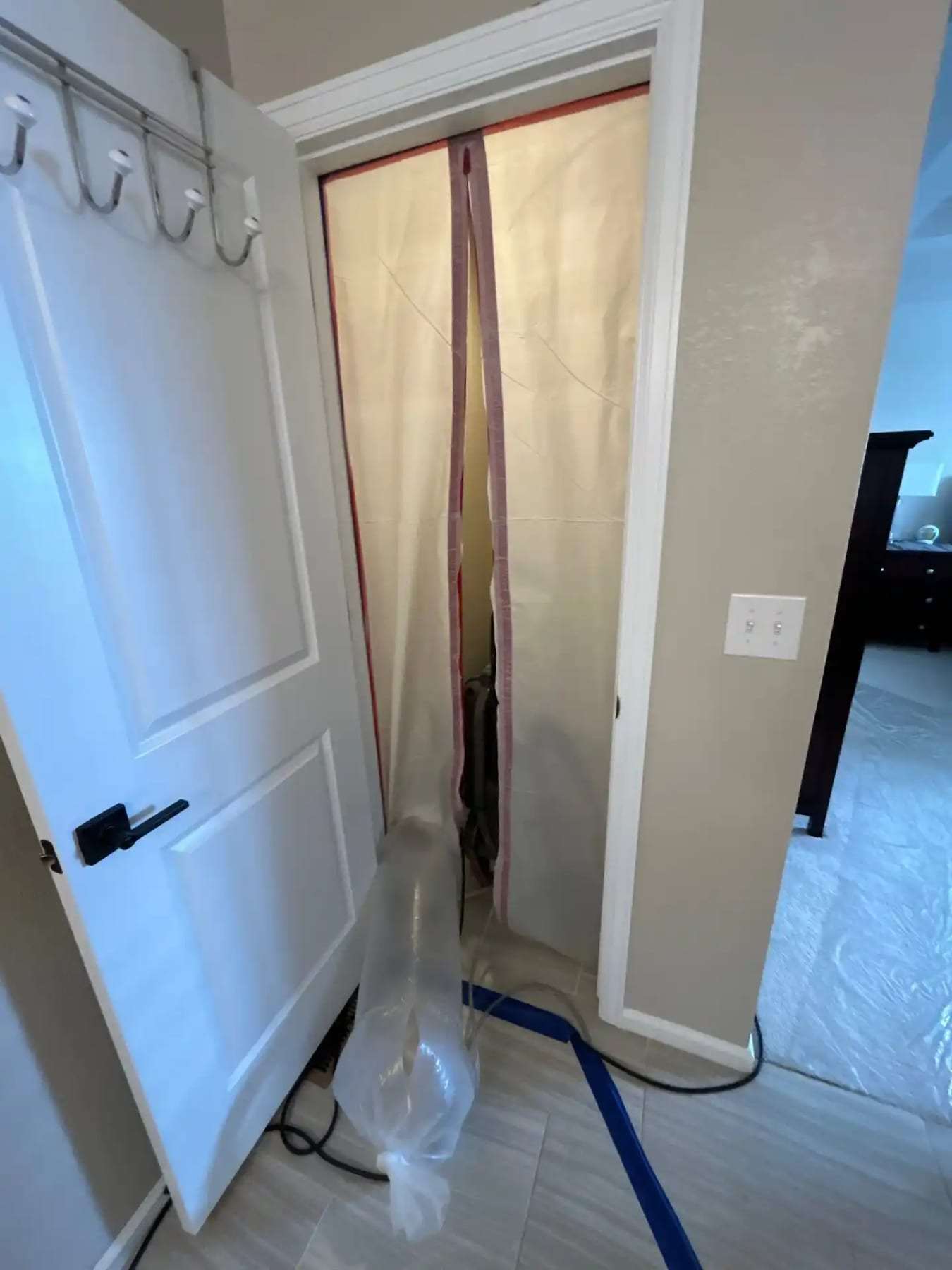
Zippered plastic containment door across a bedroom doorway. One example of what this stage can look like; it is not a job connected to this site.
What happened
Illustrative example. Not a real job or customer.
A tenant uses a basement bedroom closet for storage. In late spring, they pull out cardboard boxes and find the bottoms soft and the drywall behind them spotted with dark growth up to about knee height. The closet backs onto the foundation wall next to a window well.
- The tenant photographs the wall and the boxes, moves belongings out, and closes the closet door.
- They send the landlord an email the same evening with photos, the location, and the date of discovery, following the notice method in the lease.
- The landlord replies the next day and arranges for a contractor to inspect within the week.
- The contractor finds the window well outside full of leaves and silt, with its drain buried, and water staining on the concrete inside.
- Containment is set up in the bedroom, the closet drywall and part of the bedroom wall are removed, and framing is cleaned and dried.
- The landlord has the window well cleaned, its drain cleared, and a cover installed.
The tenant was asked to sleep in another bedroom for several days during removal. Damaged boxes and stored paper were discarded and photographed for the tenant's renters insurance.
Why the tenant's actions mattered
Prompt written notice
A dated email with photos created a clear record of when the landlord was informed.
No aggressive cleaning
Leaving the growth undisturbed kept spores from spreading and preserved evidence of extent.
Cooperation with access
Making the room available quickly shortened the time the problem went on.
Separate claim for belongings
Renters insurance, not the landlord's policy, is often where a tenant's belongings are covered.
Questions a tenant in this spot might ask
- What caused the moisture, and has it been fixed?
- Do I need to stay out of the room, and for how long?
- Will you send a short written summary of the work done?
- Who is responsible for checking the window well going forward?
Common questions
Was the tenant responsible because boxes were against the wall?
In this example, the water came from a clogged window well outside, which tenants usually do not maintain unless the lease says so. Storing items against a foundation wall can hide a problem longer, though, so a few inches of space is a good habit.
Does renters insurance cover moldy belongings?
It depends on the policy and the cause. Many renters policies cover belongings damaged by sudden water but limit or exclude mold. Read the policy and ask the agent.
Is this a real case?
No. It is an illustrative composite and does not describe any real tenant, landlord or property.
General information for Highlands Ranch, not a quote or professional advice. In an emergency, call 911.