The two questions behind every decision
- How porous is it?
- Non-porous items clean well; porous items absorb growth and usually go
- How long was it wet?
- Items dried within a day or two fare far better than those wet for weeks
- Was the water clean?
- Sewage or flood water changes the answer for almost everything porous
- What is it worth to you?
- Irreplaceable items may justify professional cleaning even when replacing would be easier
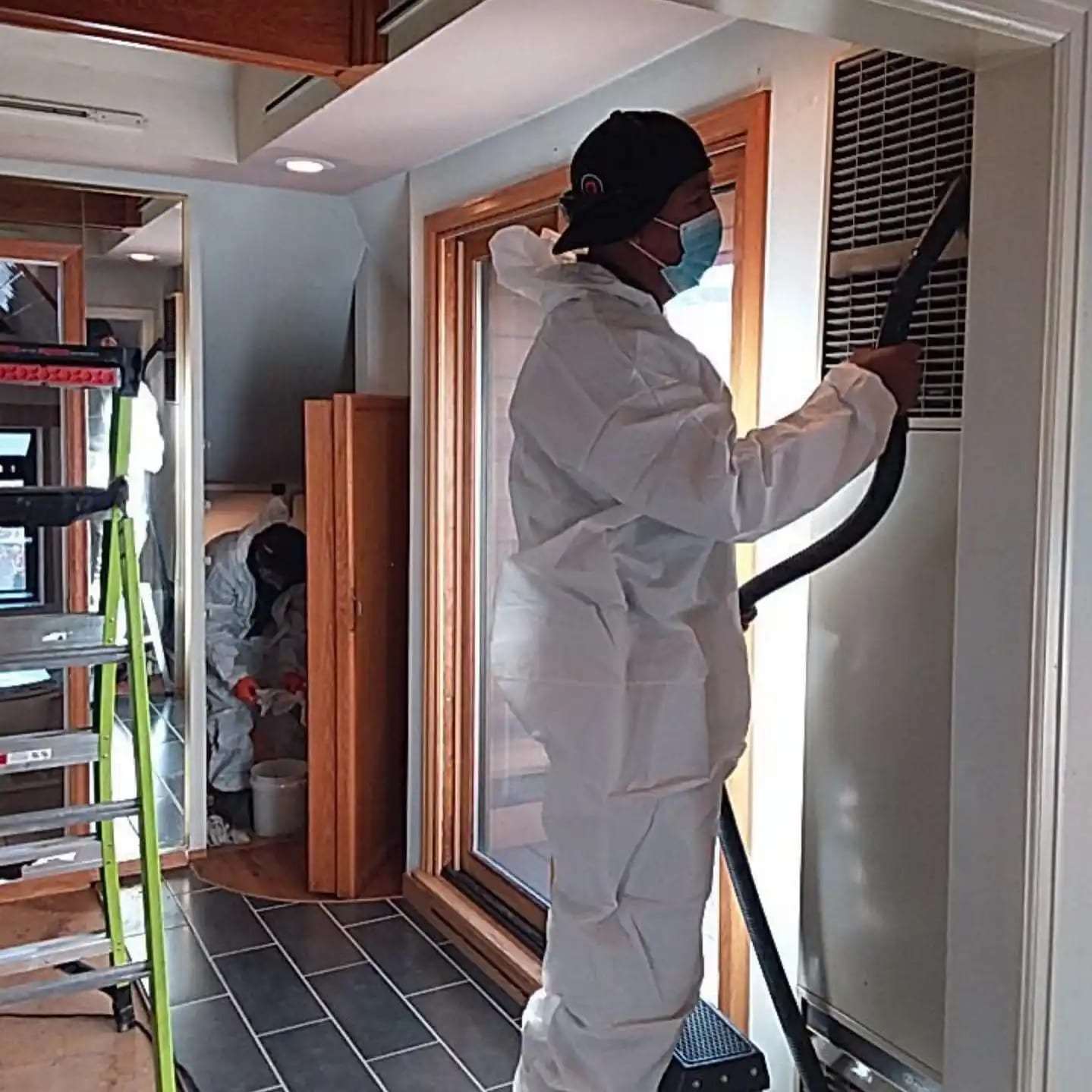
Technician in a protective suit vacuuming the trim around a window. A representative photo of the task, not a record of work at any particular property.
Building materials
| Material | Porosity | Usual recommendation with visible growth |
|---|---|---|
| Drywall | Porous | Remove affected sections, cutting beyond visible growth |
| Fiberglass batt insulation | Porous | Remove and replace |
| Carpet pad | Porous | Remove and replace |
| Carpet | Porous | Usually removed if wet for days or showing growth |
| Wood studs and joists | Semi-porous | Clean, sand if needed, dry; replace if structurally weakened |
| Plywood and OSB sheathing | Semi-porous | Clean if sound; replace if soft or delaminated |
| Particleboard cabinets | Porous, swells | Usually replace if swollen or growth is present |
| Painted trim | Semi-porous | Often replaced because it is inexpensive; can be cleaned if sound |
| Concrete | Semi-porous | Clean and dry |
| Tile, glass and metal | Non-porous | Clean |
Household belongings
| Item | Usual approach | Notes |
|---|---|---|
| Hard plastic, glass, metal | Clean with detergent and dry | Usually fine |
| Washable clothing and linens | Launder, possibly twice | Discard if staining or odor remains |
| Upholstered furniture | Assess case by case | Growth inside cushions is hard to remove |
| Mattresses | Usually discard if growth is present | Porous and hard to clean |
| Books and papers | Discard unless valuable | Freeze valuable papers and consult a conservator |
| Cardboard boxes | Discard | Repack contents in plastic bins |
| Photos and documents | Scan, then consult a conservator for originals | Act quickly |
| Electronics | Have them inspected | Do not power on if they were wet |
Making peace with the pile
Sorting belongings after a mold problem is tiring and often emotional. A practical rule is to decide quickly on anything inexpensive and replaceable, and spend your energy on items that matter. Cleaning a stack of moldy cardboard boxes or a cheap particleboard shelf rarely makes sense.
Do the sorting outside or in the garage when possible, wearing gloves and an N95 respirator, and move cleaned items into a clean room only after they are fully dry.
When the chart is not enough
A chart describes the usual call, not every case. A solid wood dresser with surface growth on the back panel is usually cleaned, but the same dresser with a particleboard back that stayed wet for weeks may not be worth the effort. Ask whoever is doing the work to explain each removal in plain terms: how wet the material got, for how long, and whether growth is on the surface or inside it.
Highlands Ranch homes often have finished basements with carpet over a slab, drywall down to the floor and built-in cabinetry. Those are the materials most likely to need removal after a slow leak or sump failure, while concrete, metal framing and sealed tile usually clean up well once the moisture source is fixed and the space is dry.
General information for Highlands Ranch, not a quote or professional advice. In an emergency, call 911.